
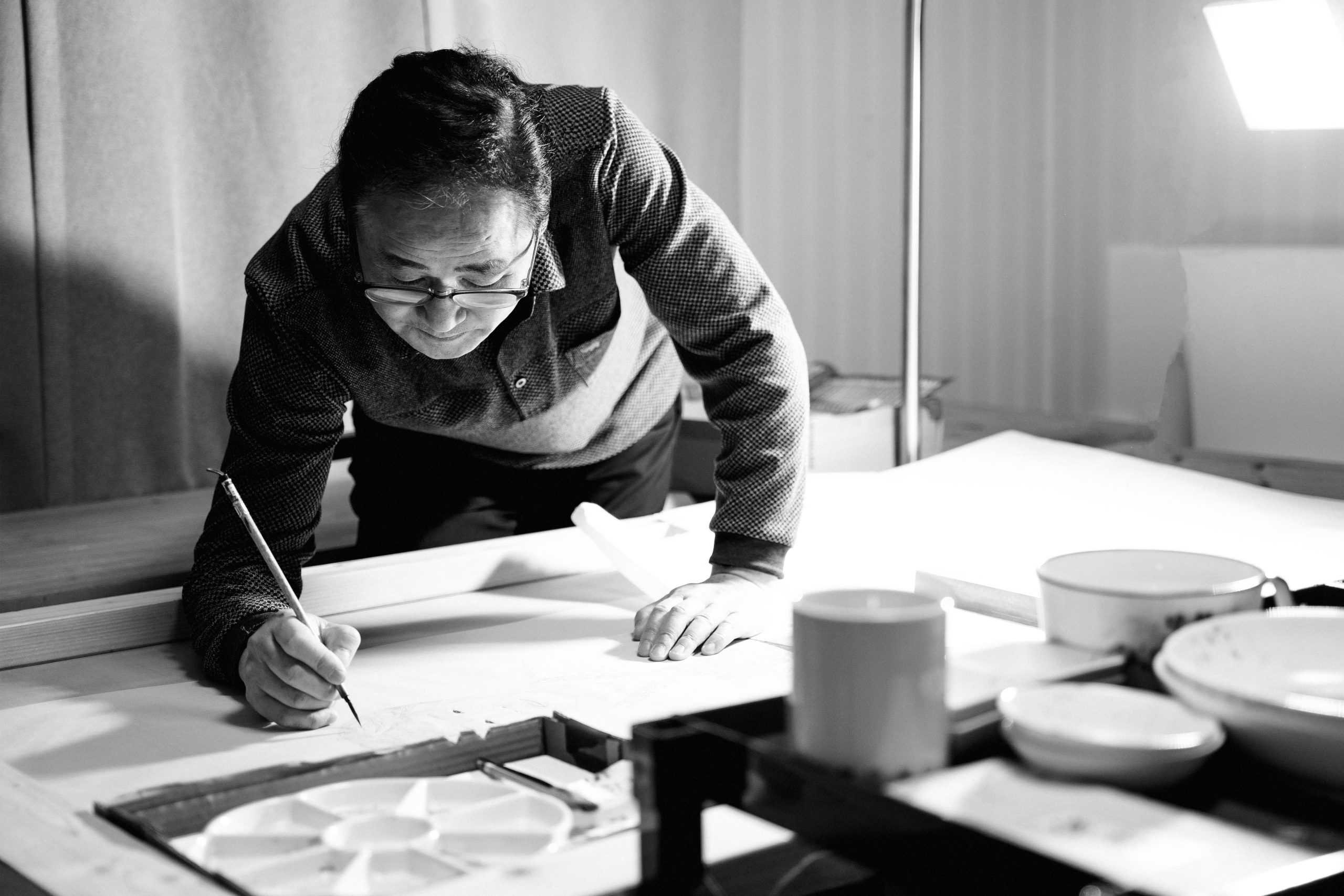
권성호 Kwon Sung-ho
작가 일대기 Artist Biography
푸른 바다의 서정 The Lyricism of the Blue Sea
전남 완도군 금당면의 작은 섬. 소년 권성호는 밀려오는 푸른 파도와 드넓은 바다를 품에 안고 자랐습니다. 자연이 매일같이 베풀어주던 다채로운 빛깔과 섬세한 바람의 결은 소년의 영혼에 누구도 흉내 낼 수 없는 서정적 감수성을 선물했습니다. 그 시절 바다가 심어준 평온한 자연의 심상은 평생에 걸쳐 그의 붓끝을 움직이는 예술적 기원이 되었습니다.
Kwon Sung-ho was born on a small island in Geumdang-myeon, Wando-gun, Jeollanam-do. As a child, he grew up surrounded by the rolling blue waves and the vast expanse of the sea. The shifting colors of nature and the delicate texture of the island winds nurtured in him a lyrical sensibility uniquely his own. The tranquil images of nature planted by the sea in his early years became the artistic source that would guide his brush throughout his life.
시대의 상흔과 자유 The Scars of an Era and the Meaning of Freedom
가장 찬란해야 할 청춘의 초입이었던 고등학교 시절, 소년은 1980년 광주 민주화 운동의 참혹한 현장 한복판에 서 있었습니다. 이름 모른 동지가 어깨를 맞댄 채 쓰러지던 순간, 옷가지만 겨우 걸친 채 참혹하게 훼손되어 리어카에 실려 가던 이들의 실루엣은 소년의 가슴에 깊은 상흔으로 남았습니다. 국가 폭력 앞에 짓밟힌 인간의 존엄을 목격하며, 소년은 예술이 시대의 아픔을 어떻게 기록하고 어루만져야 하는지, ‘자유’라는 가치가 얼마나 숭고한 것인지를 뼈저리게 깨달았습니다.
During his high school years, at the very threshold of youth, Kwon found himself in the midst of the brutal reality of the 1980 Gwangju Democratization Movement. The sight of an unnamed comrade collapsing beside him, and the silhouettes of wounded citizens being carried away on handcarts, left deep scars in his young heart. Witnessing human dignity crushed under state violence, he came to understand with painful clarity how art must record and console the wounds of its time, and how profound the value of freedom truly is.
결핍을 넘어선 열정, 포대 캔버스 Passion Beyond Hardship: The Rice-Sack Canvas
1982년 호남대학교 미술학과에 입학하며 본격적인 서양화가의 길을 걷기 시작했습니다. 그러나 예술을 향한 열정만큼 현실의 삶은 녹록지 않았습니다. 물감 하나, 캔버스 한 장 마음 놓고 살 수 없던 가난 속에서도 그는 포기하지 않았습니다. 쓰레기장을 뒤져 주워온 정부미(政府米) 포대 자루를 씻고, 그것들을 한 땀 한 땀 바느질로 이어 붙여 커다란 캔버스를 만들었습니다. 그 거친 종이 포대 위에 그가 그려 넣은 것은 ‘바다에 나간 자식을 애타게 기다리는 어머니의 젖은 눈망울’이었습니다.
In 1982, he entered the Department of Fine Arts at Honam University and began his path as a painter in earnest. Yet the realities of life were far from easy. In poverty, unable to purchase even paints or a single canvas without hesitation, he refused to give up. He searched through refuse piles, collected discarded government-issued rice sacks, washed them, and stitched them together by hand to create a large makeshift canvas. Upon that rough paper surface, he painted the tearful eyes of a mother anxiously waiting for her child who had gone out to sea.
결핍은 장애물이 아니었습니다. 거친 포대 주름 사이에 스며든 것은 삶의 어떠한 역경에도 굴하지 않고 붓을 쥐어내던 청년 권성호의 가장 뜨거운 예술혼이었습니다.
Hardship was never an obstacle. What seeped into the creases of those rough sacks was the fervent artistic spirit of the young Kwon Sung-ho, who held fast to his brush and refused to yield to adversity.
필묵과 색채의 융합, 법고창신 The Fusion of Ink, Brush, and Color
그의 예술은 끊임없이 진화하며 정면 돌파의 여정을 그려왔습니다. 청년기의 고뇌에 찬 자화상에서 시작하여, 일상의 깨달음이 주는 평온함을 거쳐, 마침내 소나무와 인체를 동일 공간에 배치하는 성숙기에 도달했습니다. 그는 자연을 거대한 ‘어머니의 품’이자 ‘고향’으로 바라보고, 인체의 곡선을 통해 삶의 희로애락을 직관적으로 표현했습니다. 나아가 전통 동양화의 정신에 매료된 그는 원광대학교 대학원에서 회화 문화재 보존수복학을 공부하며 조선 시대 초상화 기법을 깊이 연구했습니다. 옛 선인들의 전통 필묵법과 보존·복원의 정교한 기술을 습득하여 서양화의 풍부한 색채감과 동양화의 깊이 있는 여백을 결합하는 ‘법고창신(法古創新)’의 경지를 구축해 나가고 있습니다.
Kwon’s art has continued to evolve through a lifelong process of inquiry and creative breakthrough. Beginning with the anguished self-portraits of his youth, moving through the serenity born from everyday reflection, he eventually arrived at a mature pictorial language in which pine trees and the human body coexist within the same space. He regards nature as both a vast maternal embrace and a place of origin, while expressing the joys and sorrows of life through the organic curves of the human form. Drawn to the spirit of traditional Korean and East Asian painting, he went on to study the conservation and restoration of painted cultural heritage at Wonkwang University Graduate School, with a particular focus on Joseon-era portrait techniques. By mastering traditional brush-and-ink methods as well as refined conservation and restoration practices, he continues to pursue the principle of Beopgo Changsin—creating the new by learning from the old—bringing together the rich chromatic sensibility of Western painting and the contemplative depth of Eastern pictorial space.
역사와 인간을 기억하는 붓 A Brush That Remembers History and Humanity
권성호 작가에게 있어 그림은 아름다운 자연과 기하학적 유희에만 머물지 않습니다. 권성호 작가는 아픈 역사를 망각하지 않고 기억하는 것이 예술가의 숭고한 소명이라고 믿습니다. 그는 1980년 오월 광주의 상흔을 생생히 증언하는 5.18 민주화 운동 기록화뿐만 아니라, 모진 역사 속에서 깊은 상처를 입었던 일본군 ‘위안부’ 피해자 할머니들의 영혼을 기리는 작품들을 화폭에 담아내고 있습니다. 캔버스 위에 새겨진 인물들의 묵직한 선과 눈빛은 역사의 가려진 진실을 고발하고, 어떠한 풍파 속에서도 지워지지 않는 인간 존엄의 가치를 엄숙히 환기시킵니다.
For Kwon Sung-ho, painting is not confined to beautiful landscapes or geometric play. He believes that to remember painful history, rather than allowing it to fade into oblivion, is one of the artist’s most solemn callings. His works include documentary paintings that bear vivid witness to the wounds of Gwangju in May 1980, as well as paintings that honor the spirits of surviving victims of Japanese military sexual slavery, often referred to as “comfort women,” who endured profound suffering in a cruel chapter of history. The weighty lines and solemn gazes of the figures inscribed on his canvases expose truths obscured by history and remind us of human dignity—an enduring value that no storm of time can erase.